

Introduction
Most travelers who visit Tangier do so because their itinerary requires it: they are arriving by ferry from Spain, or they are building a north-to-south Morocco Trip and Tangier is the logical starting point. What surprises nearly all of them is that Tangier turns out to be genuinely interesting in its own right, not just as a transit city but as a destination that has accumulated centuries of history, cultural contradiction, and a specific kind of atmospheric beauty that is unlike anywhere else in Morocco.
This guide is written to help you experience Tangier properly rather than simply pass through it. It covers what makes the city distinctive, how to structure your time across one to three days, which day trips deserve the extra effort, and how Tangier connects into a broader Morocco Itineraries plan that flows efficiently across the country. If you want your time in the north to feel coherent rather than improvised, organizing your Tangier chapter through Tours From Tangier is the most reliable approach.
What makes Tangier different from every other Moroccan city
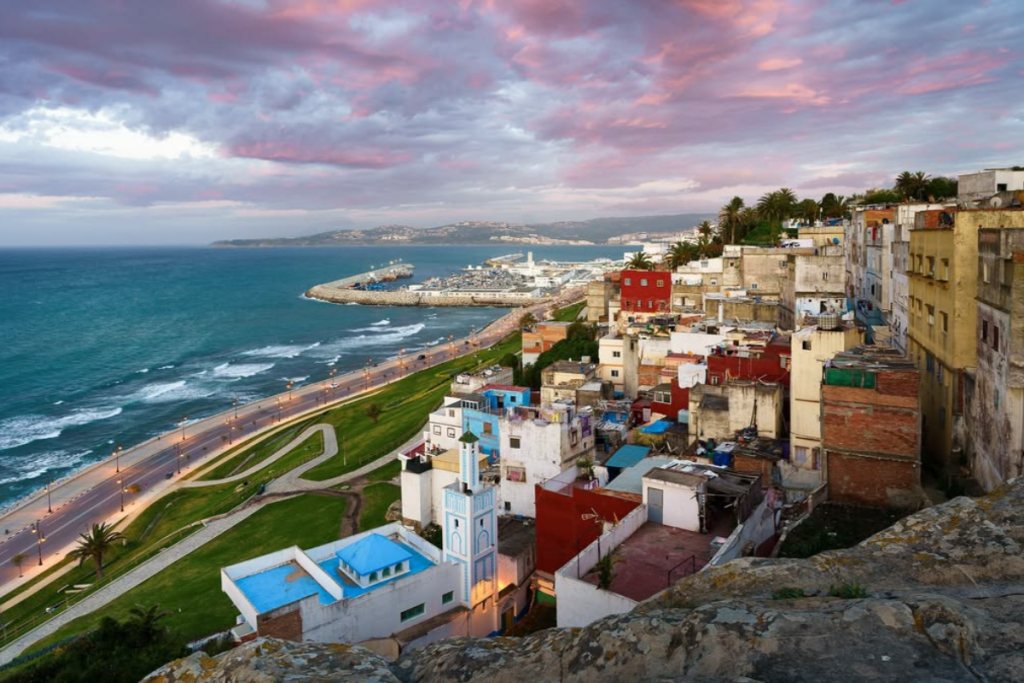
Geography shapes character, and Tangier’s geography is extraordinary. The city sits at the exact point where the Atlantic Ocean meets the Mediterranean Sea and where Africa comes within fourteen kilometers of Europe. That proximity has defined Tangier for millennia: it has been a Phoenician trading post, a Roman city, a Portuguese colony, a Spanish protectorate, a British territory, a French protectorate, and finally an international zone governed simultaneously by eight nations before Moroccan independence in 1956. No other city in Morocco carries that density of international history in its physical fabric.
The result is a city that feels layered in a way that even Fes and Marrakech — for all their depth — do not quite replicate. Spanish street signs survive alongside Arabic ones. Art Deco buildings from the international zone era sit beside traditional Moroccan medina architecture. The Spanish language appears in conversations, on menus, and on shop fronts in the northern neighborhoods. The sea is always visible or implied, giving the city a breezy, open quality that separates it completely from Morocco’s landlocked imperial cities. This is why Tangier fits so naturally into a Trip To Morocco plan as an opening chapter: it gives you an immediate sense of Morocco’s complexity without the overwhelming intensity of Fes or Marrakech on day one.
The kasbah: Tangier’s most rewarding neighborhood
The kasbah sits at the northern tip of the medina, elevated above the port with views across the Strait of Gibraltar that on clear days extend to the Spanish coast. It is a neighborhood rather than a single building, and its character is distinctly different from the commercial energy of the lower medina: quieter, more residential, with narrow lanes opening occasionally into small squares where cats sleep in patches of afternoon light and the sound of the sea arrives between buildings.
The Kasbah Museum, housed in a former sultan’s palace, is worth the entrance fee not only for its collection of Moroccan and Roman artifacts but for the building itself: tiled courtyards, carved doorways, and rooms decorated in the full vocabulary of traditional Moroccan craftsmanship. The Contemporary Art Museum, in the restored former kasbah prison, adds a more recent cultural layer. Together they give you two hours that feel genuinely enriching rather than simply obligatory, and the walk between them through the kasbah lanes is as rewarding as the museums themselves.
The Grand Socco and medina entrance: where Tangier’s histories meet
The Grand Socco is a large square at the top of the medina that functions as a kind of hinge between the old city and the French-era Ville Nouvelle. Its name combines Arabic and Spanish in a way that is entirely characteristic of Tangier: “socco” is a corruption of the Arabic “souk,” filtered through Spanish colonial usage into a word that belongs to neither language and to the specific place that is Tangier. The square was historically a market meeting point, and it still has something of that gathering character: people pass through it constantly, cafés line its edges, and it provides one of the clearest views down into the medina from above.
Entering the medina from the Grand Socco takes you through the Bab Fahs gate and into a network of lanes that are smaller and less commercial than Marrakech’s souks but more genuinely inhabited. The Petit Socco, the small square at the medina’s heart, was the nerve center of Tangier’s international zone era: banks, hotels, and the cafés where diplomats and writers and traders conducted their complicated business in the mid-twentieth century. It is quieter now, but the atmosphere of layered significance is still there for travelers who arrive knowing what they are looking at.
The American Legation Museum: the most historically significant building in Tangier
In 1777, Morocco became the first country in the world to officially recognize American independence. The building that the Moroccan sultan gifted to the United States government in 1821 — the first American diplomatic property established anywhere outside the United States — still stands in Tangier’s medina and now operates as the American Legation Museum. It is one of the most genuinely important historic buildings in Morocco and one of the least visited by travelers on standard itineraries.
The museum’s collection covers the diplomatic relationship between Morocco and the United States across two centuries, with paintings, documents, maps, and personal effects that frame Tangier’s international history from an angle that most Morocco travel rarely addresses. The building itself is worth the visit independently of the collection: a five-story Moorish structure with tiled courtyards and carved details that has barely changed since the nineteenth century. Spend an hour here on your first full day in Tangier and the rest of the city becomes significantly more readable.
Café culture: what Tangier’s literary legacy actually means for travelers today
Tangier attracted writers in the mid-twentieth century for reasons that remain partially visible in the city today. The international zone’s relative legal ambiguity, its concentration of expatriates, and its position at the intersection of multiple cultures created an environment where unconventional lives could be lived more freely than in either Europe or the American cities many of these writers came from. Paul Bowles, William Burroughs, Truman Capote, Tennessee Williams, and others left traces in the city’s café culture that have become part of Tangier’s self-image and part of its appeal to a certain kind of culturally curious traveler.
The practical meaning for visitors is simple: Tangier has exceptionally good cafés, and sitting in them is genuinely enjoyable. The café at the Cinema Rif, the historic venues in and around the Petit Socco, and the rooftop terraces in the kasbah are all worth your time as experiences rather than merely as social media backdrops. Tangier is a city where unhurried café time does not feel like idleness. It feels like participation in something that has been going on for a long time.
Cape Spartel and the Caves of Hercules: the essential day trip
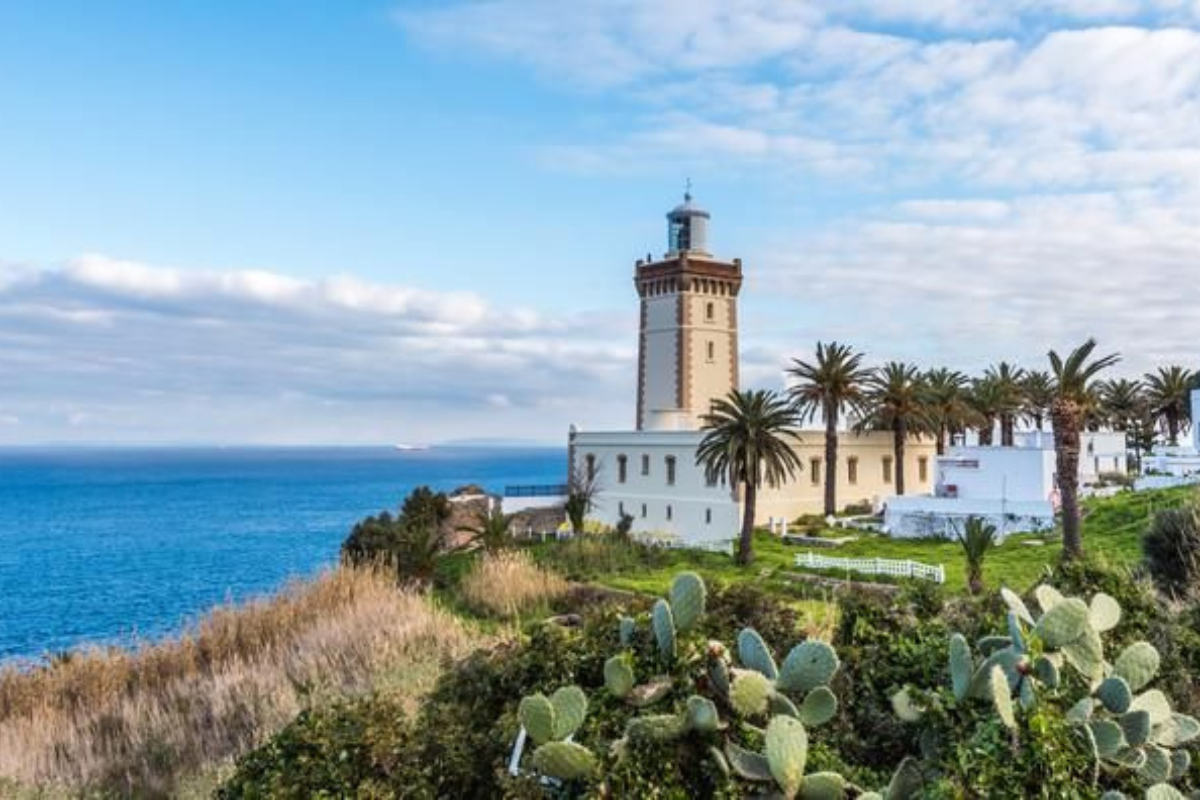
About fifteen kilometers west of Tangier, Cape Spartel marks the point where the Atlantic and Mediterranean officially meet and where Africa’s northwestern corner faces the open ocean. The lighthouse at the cape has guided ships through the strait for over a century, and the viewpoint around it offers one of the most geographically significant views available from any point in Morocco: two seas, two continents, and the narrow passage of water that has been one of the world’s most important maritime routes since antiquity.
The Caves of Hercules, a few kilometers further along the coast, add a mythological dimension that many travelers find unexpectedly compelling. The caves are part natural and part artificially enlarged by centuries of use, and their entrance — facing the sea in a shape that roughly resembles the African continent when viewed from inside — is one of those genuinely strange and memorable visual experiences that Morocco occasionally produces without warning. Including Cape Spartel and the caves as a half-day excursion from Tangier is almost always worth the hour of driving involved, and it connects naturally to the broader Morocco Excursions logic that makes northern Morocco so rewarding.
Asilah: the coastal town that rewards a full day
About forty-five kilometers south of Tangier along the Atlantic coast, Asilah is a small whitewashed town with Portuguese fortification walls, a medina that has been partially converted into a gallery and arts space, and a beach that catches the Atlantic light in ways that make it one of the most photogenic coastal spots in northern Morocco. The town hosts an international cultural festival each summer that has, over several decades, produced an extraordinary collection of murals on the medina walls that give it a visual character unlike any other Moroccan town.
Asilah works well as a full-day trip from Tangier: morning in the medina and along the ramparts, lunch in one of the seafood restaurants near the port, and an afternoon on the beach before returning north. The pace is slower and the atmosphere is calmer than Tangier, and many travelers find that a day in Asilah resets their energy in ways that allow them to appreciate Tangier more on their return. Including this as part of Tangier Morocco Tours planning ensures that the transport and timing are handled without eating into your actual exploration time.
Chefchaouen as an extension from Tangier
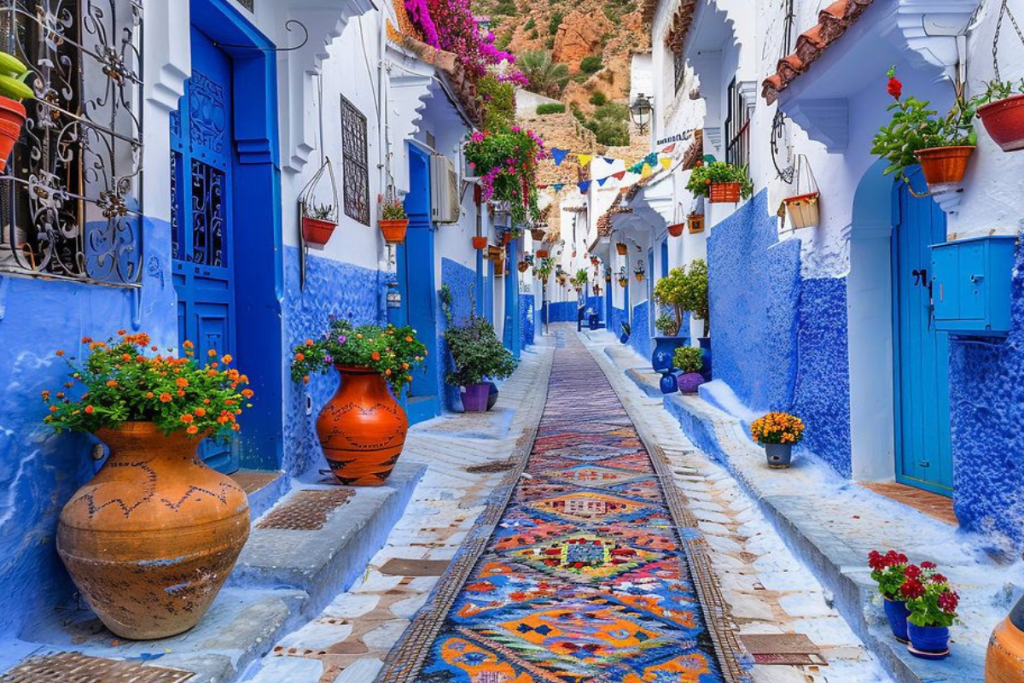
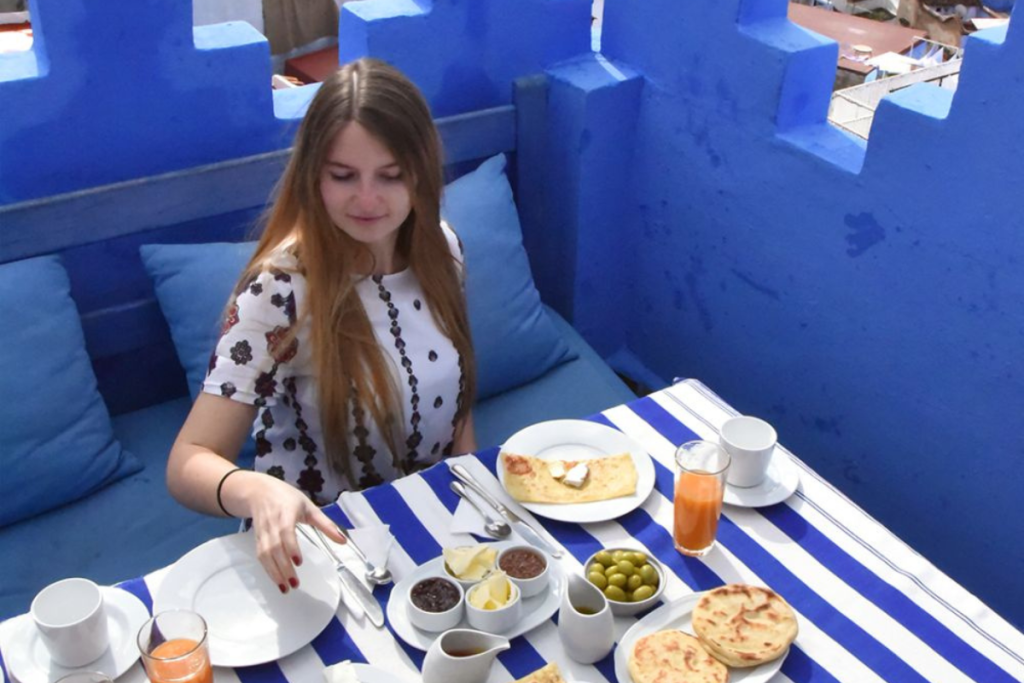
The blue mountain town of Chefchaouen sits about two and a half to three hours from Tangier by road and is one of the most immediately striking places in Morocco: a medina painted in graduated shades of blue and white, set against the Rif Mountains in a way that makes almost every photograph look like it was carefully composed. The town is famous enough to be busy during the day, particularly in peak tourist season, but quiet enough in the early morning and evening to feel genuinely peaceful.
From Tangier, Chefchaouen works either as an overnight extension or as part of an onward route toward Fes. The combination of Tangier’s coastal and international character, Chefchaouen’s mountain calm, and then Fes’s medina intensity creates one of the most satisfying northern Morocco sequences available, covering genuine variety in a logical geographic progression. This kind of connected routing is exactly what Trips To Morocco planning benefits from most: the destinations are individually excellent, but their sequence is what gives the trip its coherence.
How Tangier connects to a complete Morocco route
Tangier’s most valuable role in a Morocco itinerary is as the opening chapter of a north-to-south journey, and this format consistently produces the strongest overall travel experience. Starting in Tangier, moving through Chefchaouen, continuing to Tours From Fez for cultural depth, then heading south toward the Sahara before finishing in Tours From Marrakech, gives you a Morocco that changes at every stage and never repeats itself.
For travelers with a specific timeline, a 10 Days Morocco Itinerary From Tangier can cover this entire arc in a way that feels full without feeling rushed. A 12 Days Morocco Tour starting from Tangier adds room for a desert chapter and a slower pace throughout, which many travelers find produces a more satisfying experience than a tighter schedule. And a full 7 Days Morocco Itinerary from Tangier can cover the north comprehensively if the desert and far south are reserved for a future trip.
For travelers who want the flexibility of a structured plan without a rigid schedule, organizing the route through Private Morocco Tours or a tailored Custom Morocco Travel Itinerary gives you the best of both worlds: the logistical reliability of a planned route with the day-to-day flexibility to spend more time in places that surprise you. Connecting Tangier to Tours From Casablanca Morocco at the end of the route is also a clean finishing option for travelers whose return flights depart from Casablanca rather than Tangier.
Practical tips for getting the most from Tangier
Tangier’s medina is significantly less pressured than Marrakech or Fes in terms of persistent sales attention, which makes it an excellent medina to navigate independently from the first day. The kasbah area is especially relaxed and is the part of the city where unhurried wandering consistently produces the strongest impressions. Give yourself at least a morning there without a specific agenda and let the neighborhood reveal itself at its own pace.
The city’s transport connections are strong: the high-speed Al Boraq train connects Tangier to Casablanca and Rabat in comfortable modern trains with reserved seating, making the rail journey itself a pleasant and efficient part of the itinerary. For day trips to Cape Spartel and Asilah, organized transport through Tours From Tangier is more reliable than negotiating individual taxis, particularly for timing-sensitive excursions where you want to arrive at specific viewpoints at specific times of day.
Plan at least two nights in Tangier. One day allows you to cover the main medina highlights and one viewpoint. Two days allows you to add the American Legation Museum, a proper kasbah walk, one day trip, and the café time that makes the city feel genuinely experienced rather than merely checked off. Three days, with Asilah and Cape Spartel each having their own proper time, produces the strongest impression of what northern Morocco has to offer.
Tours From Tangier:
5 Days in Northern Morocco From Tangier
5 Days Morocco Desert Tour from Tangier
6 Days Morocco Tour from Tangier
7 Days Morocco Sahara Tour From Tangier
10 Days Morocco Holiday from Tangier
13 Day Morocco Tour from Tangier
Conclusion: give Tangier the credit it has earned
Tangier is one of those cities that has been undersold to travelers for so long that discovering its actual qualities feels like a private revelation. The literary mythology helps attract a certain kind of visitor, but the city’s real appeal is more straightforward: it is beautiful in an unusual way, historically extraordinary, geographically dramatic, and far more rewarding than its reputation as a transit city suggests.
Build your Tangier chapter with genuine time, organize it through Tangier Morocco Tours, and connect it to the rest of your Morocco Travel Packages plan through Trips To Morocco Tours. The city will exceed your expectations, and your Morocco itinerary will be stronger for having included it properly rather than treating it as the place you landed before the real trip began.
